

 Loading...
Hidden Pairs Mahjong: The Ultimate Memory and Strategy Challenge
The world of online puzzle games is vast, but few combine serene aesthetics, deep strategy, and a profound cognitive workout quite like Hidden Pairs Mahjong. Distinct from traditional tile-matching Mahjong Solitaire, this variant focuses exclusively on memory and pattern recognition, offering a pure and engaging brain training experience. This long-form guide dives deep into the intricacies of Hidden Pairs Mahjong, exploring its rules, benefits, advanced strategies, and its rightful place in the pantheon of great memory games.
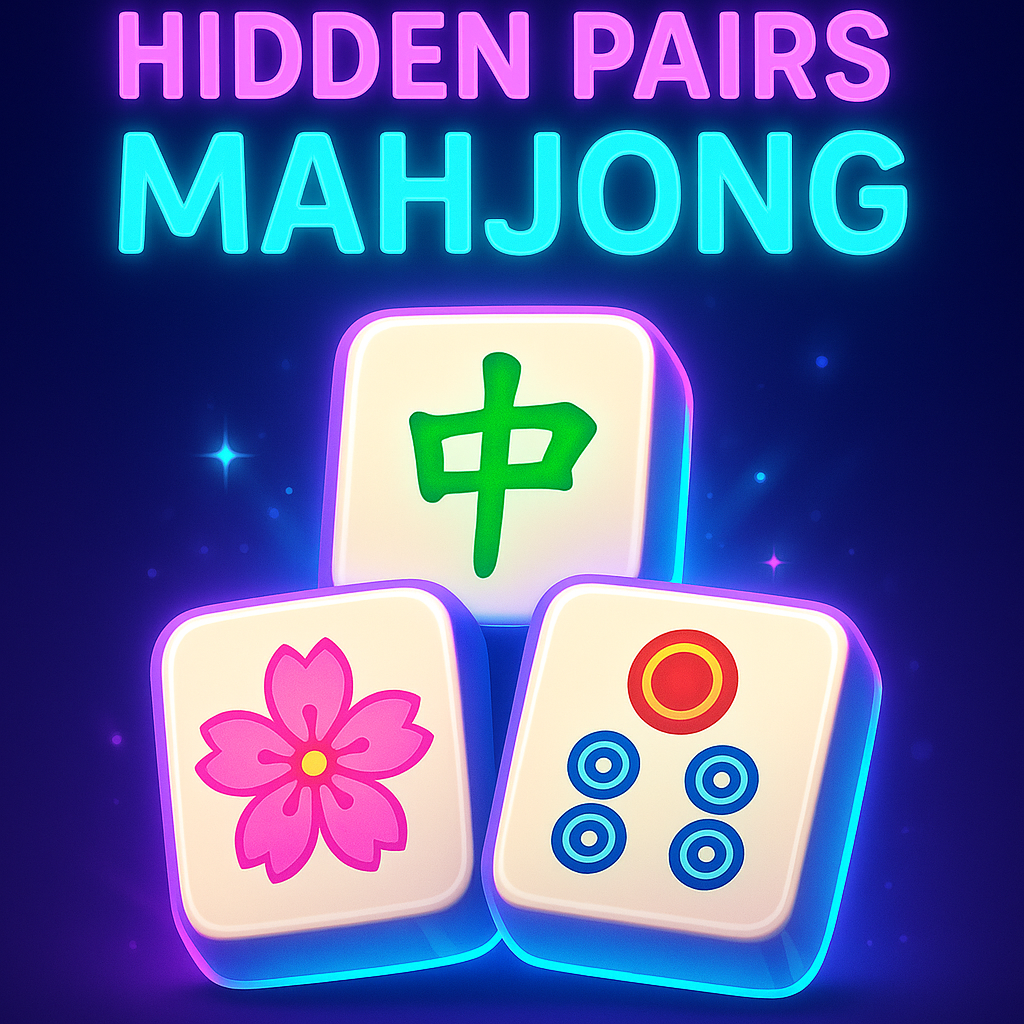
What is Hidden Pairs Mahjong?
At its core, Hidden Pairs Mahjong is a card-matching memory game dressed in the beautiful, traditional attire of Mahjong tiles. The game board is typically laid out with a set of tiles arranged in a grid, all facing down. Your objective is simple: flip over two tiles at a time to find matching pairs. When a matching pair is revealed, those tiles are removed from the board. The game is won when all tile pairs have been successfully found and cleared.
This deceptively simple premise belies a game of intense concentration and spatial memory. Unlike Mahjong Solitaire, there are no layers or stacks to navigate based on "free" tiles. Every tile is accessible from the start, but their hidden identities are the puzzle. The challenge of Hidden Pairs Mahjong comes from memorizing the location of specific tile faces after they are briefly revealed, allowing you to make successful matches on subsequent turns. It strips away the complex rules of the classic Mahjong set game and focuses purely on the cognitive skill of recall.
Key Differences from Traditional Mahjong Solitaire
- Mechanics: Based on memory matching, not on removing free identical tiles from a layered structure.
- Tile State: All tiles begin face-down. In Solitaire, all tiles are face-up from the beginning.
- Strategy: Relies almost entirely on spatial memory and recall. Solitaire involves strategic planning of tile removal to avoid dead ends.
- Accessibility: All tiles are immediately clickable/flippable, whereas Solitaire tiles must be "free" (not blocked on left and right).
The Cognitive Benefits of Playing Hidden Pairs Mahjong
Engaging regularly with Hidden Pairs Mahjong is more than just a pleasant pastime; it's a legitimate exercise for your brain. As one of the most focused memory games available, it targets and strengthens several key cognitive domains.
1. Enhanced Short-Term and Visual Memory
The fundamental action of the game—seeing a tile and remembering its location—is a direct workout for your visual-spatial short-term memory, also known as your "working memory." This is the mental notepad you use to hold information temporarily. By constantly loading tile images and their grid coordinates into this mental space, you train your brain to retain visual information more efficiently and for longer durations.
2. Improved Concentration and Focus
Success in Hidden Pairs Mahjong demands unwavering attention. A single lapse in concentration can cause you to forget a crucial tile location, costing you moves or even the game. This practice in sustained focus can translate to improved attention spans in daily life, helping with tasks that require deep work or detailed observation.
3. Pattern Recognition Skills
While primarily a memory game, advanced play involves subconscious pattern recognition. You begin to recognize not just individual tiles, but clusters or relationships between tile positions. This skill is fundamental to fields like mathematics, coding, and even social interaction, where recognizing patterns in data or behavior is key.
4. Stress Reduction and Mindfulness
The rhythmic, repetitive nature of searching for pairs, combined with the often-soothing visual and audio design of Hidden Pairs Mahjong games, can induce a state of light mindfulness. It pulls your focus away from daily anxieties and into the present moment of the puzzle, providing a mental break that can lower stress levels.
| Cognitive Skill | How Hidden Pairs Mahjong Trains It |
| Visual-Spatial Memory | Memorizing the location of specific tile faces on a grid. |
| Concentration | Requiring sustained attention to track multiple tile locations over time. |
| Pattern Recognition | Identifying relationships between tile positions and types subconsciously. |
| Mental Speed | Quickly processing and recalling visual information to minimize turns. |
| Cognitive Flexibility | Adapting your memory strategy as the board clears and new layouts form. |
Mastering the Game: Beginner to Advanced Strategies
Anyone can click tiles randomly, but mastering Hidden Pairs Mahjong involves developing and employing deliberate strategies. Here's a progression of tactics to improve your gameplay and lower your move count.
Beginner Foundation: The Systematic Scan
When you first start, discipline is key. Don't flip tiles at random. Adopt a methodical approach:
- Row-by-Row or Column-by-Column: Start at the top-left corner and flip tiles in sequence, committing their identity and location to memory as you move systematically across the grid.
- The "First Pass": Your initial goal isn't to make matches immediately (unless you happen upon two identical tiles in sequence). The goal of the first pass is to gather intelligence. You are building a mental map of the board.
- Make Easy Matches: As you scan, if you flip a tile and vividly remember the location of its match from earlier in your scan, make that match immediately to clear tiles and simplify the board.
Intermediate Tactics: Chunking and Edge Prioritization
Once you're comfortable with the basics, you can start using more efficient mental models.
- Chunking Information: Instead of remembering "Bamboo 3 at B-5," try to group tiles. Remember that the top-right quadrant has two Flower tiles and a Red Dragon. This technique, called chunking, allows your working memory to hold more information by grouping related items.
- Focus on Corners and Edges First: Tiles on the periphery are often psychologically easier to remember because they have a distinct spatial anchor (e.g., "the tile in the very bottom-left corner"). Clearing edges can also help visually declutter the board faster.
- Use Failed Matches: A flipped pair that doesn't match isn't a waste. It's two more tiles you now know! Add these new identities firmly to your mental map.
Advanced Play: Mental Mapping and Predictive Play
Expert players of Hidden Pairs Mahjong treat the game like a chess match, thinking several flips ahead.
- Build a Dynamic Mental Map: Don't just remember static locations. As the board clears, update your mental image. The empty spaces become part of the map, helping you re-anchor the locations of remaining tiles.
- The "Sacrificial Flip": In the late game with few tiles left, you may know the location of one tile in a pair but not the other. If you have to guess the location of the match, plan your flip. Choose a tile that, even if it's wrong, reveals new information that will help you locate the final pairs. You're using a turn to gather critical intelligence.
- Track Your Efficiency: Many digital versions of Hidden Pairs Mahjong track your moves or time. Set personal goals to complete the same board layout in fewer moves each time you play. This metric forces you to optimize your memory strategy.
The Art and Design of Hidden Pairs Mahjong Tiles
A significant part of the appeal lies in the artwork. While the game mechanics are universal, the visual design of the tiles can greatly affect the experience and difficulty. Most digital versions use the classic tile sets derived from the physical Mahjong set.
Common Tile Suits and Honors
Understanding the tile designs isn't necessary to play the memory game, but it enriches the cultural experience and can actually aid in differentiation:
- Circles (Dots): Simple circular designs, numbered 1-9. Can be tricky to differentiate at smaller sizes, especially 1 vs. 8.
- Bamboos (Bams): Stylized bamboo sticks, with the 1 Bamboo often depicted as a bird. The number of sticks increases with the number.
- Characters (Cracks): Complex Chinese numerals on a rectangular background. Often the most visually "busy" suit.
- Honor Tiles: These are often the easiest to spot and remember because they are unique. They include the Winds (East, South, West, North) and Dragons (Red, Green, White). Their distinct symbols make them prime targets for early matching in a game of Hidden Pairs Mahjong.
- Bonus Tiles: Flowers and Seasons. These are typically the most ornate and varied tiles, making them very easy to distinguish from the suits and from each other.
The choice of tile set can impact the game's difficulty. A set using only the three numbered suits (108 tiles, meaning 54 pairs) is much harder than a set that includes all the unique Honors and Bonuses, as the latter provides more distinct visual cues. For a classic and beautifully rendered digital experience, you can find an excellent version at Play123's Hidden Pairs Mahjong.
Variations and Modern Digital Adaptations
The core concept of Hidden Pairs Mahjong is highly adaptable, leading to numerous digital variations that keep the gameplay fresh.
Popular Digital Variations
- Timed Challenges: Adding a countdown timer transforms the game from a meditative puzzle into a heart-pounding race against the clock, testing recall under pressure.
- Multi-Level Progression: Games may feature increasingly complex boards—starting with a 4x4 grid of 8 pairs and progressing to massive 10x10 grids with 50 pairs. Each level may introduce new, more intricate tile sets.
- Themed Tile Sets: Developers often release versions with holiday themes (e.g., Halloween pumpkins, Christmas ornaments) or other motifs (animals, gemstones, famous artwork). This keeps the memory games mechanic engaging through novel visuals.
- Power-Ups and Hints: Some casual versions include aids like a "Peek" power-up that briefly reveals all tiles, or a "Hint" that shows a matching pair. These are great for beginners or for overcoming a frustrating stalemate.
- Multiplayer Modes: Competitive or turn-based modes where players take turns flipping tiles on a shared board, testing who has the superior memory.
Why Hidden Pairs Mahjong Stands Out Among Memory Games
The market is flooded with brain training apps and memory games, so what makes Hidden Pairs Mahjong endure?
1. Perfect Purity of Concept: It does one thing—train visual memory—and does it exceptionally well, without unnecessary storylines or complicated meta-games.
2. Cultural and Aesthetic Depth: The use of Mahjong tiles provides a layer of artistic and cultural richness absent from simple card decks or abstract shapes. Each game feels connected to a centuries-old tradition.
3. Scalable Difficulty: The difficulty scales naturally with the number of pairs. A beginner can enjoy a small, manageable board, while a memory athlete can challenge themselves with a vast grid. The player controls their own challenge level.
4. Accessible to All Ages: The rules can be understood by a young child in seconds, yet the strategic depth can captivate adults and seniors. It is a truly intergenerational puzzle.
Integrating Hidden Pairs Mahjong into Your Cognitive Fitness Routine
To reap the maximum cognitive benefits, treat Hidden Pairs Mahjong as a workout, not just a time-filler.
- Consistency is Key: Aim for short, daily sessions of 10-15 minutes rather than a marathon session once a week. Regular, focused practice is how you build and maintain memory strength.
- Progressive Overload: Just as you lift heavier weights, you must increase the mental load. Once a board size becomes easy, immediately move to a larger, more challenging grid. Constantly push the boundaries of your working memory's capacity.
- Mix It Up: Don't just play the same themed version. Switch between different tile sets (classic, themed, abstract) to force your brain to adapt to new visual patterns and avoid autopilot.
- Combine with Other Activities: Pair your Hidden Pairs Mahjong session with other brain-healthy habits: a few minutes of physical exercise, a healthy snack, or learning a new skill. A holistic approach to cognitive fitness yields the best results.
Conclusion: The Timeless Appeal of a Memory Classic
In a digital landscape of hyper-stimulating games, Hidden Pairs Mahjong remains a testament to the power of a simple, elegant idea. It connects us to the timeless appeal of the Mahjong tile set while providing a rigorous and satisfying workout for one of our most vital cognitive functions: our memory. Whether you are seeking a tool for mental sharpness, a moment of mindful relaxation, or simply a beautifully designed puzzle, this game delivers on all fronts. Its status as a premier memory game is well-earned, offering endless layers of challenge beneath its serene and classic surface. So, the next time you have a few spare minutes, consider flipping some tiles—your brain will thank you for it.
FAQ
- Question: What specific memory skills does playing Hidden Pairs Mahjong help to train?
Answer: Hidden Pairs Mahjong primarily exercises working memory and visual-spatial recall. As you scan the board to locate and remember the positions of matching tiles that are initially hidden, you are constantly updating and manipulating information in your short-term memory. This process strengthens the brain's ability to hold and process visual details, which is a core component of working memory. Over time, consistent play can enhance your capacity for pattern recognition and improve the speed and accuracy of your visual search, skills that are transferable to tasks like finding items in a cluttered space or remembering where you placed objects. - Question: How does the gameplay of Hidden Pairs Mahjong support long-term brain health?
Answer: Engaging with Hidden Pairs Mahjong provides a form of cognitive stimulation that can contribute to neuroplasticity—the brain's ability to form and reorganize synaptic connections. The game's demand for focused attention and memory retrieval challenges the brain, potentially helping to build cognitive reserve. This reserve is thought to provide a buffer against age-related cognitive decline. By regularly exercising these neural pathways through an enjoyable activity, you are effectively giving your brain a workout that may support maintaining sharper mental faculties over the long term. - Question: Can playing Hidden Pairs Mahjong improve concentration and focus in daily life?
Answer: Yes, the core mechanics of Hidden Pairs Mahjong require sustained attention and resistance to distraction, which directly trains your concentration muscles. To succeed, you must ignore irrelevant tile patterns and maintain a mental map of discovered pairs while systematically searching the board. This practice in focused, goal-directed attention can enhance your ability to concentrate on other tasks outside the game. Players often find that the disciplined focus needed for the game helps them stay on task during work or study, reducing mind-wandering and improving productivity. - Question: What role does problem-solving play in Hidden Pairs Mahjong, and how is it beneficial?
Answer: Hidden Pairs Mahjong is a dynamic puzzle that requires strategic problem-solving. Each move involves evaluating the board state, predicting which tiles to reveal to maximize information gain, and planning several steps ahead to avoid dead ends. This engages executive functions like planning, cognitive flexibility, and strategic thinking. By regularly navigating these puzzles, you train your brain to approach problems methodically, weigh options, and adapt strategies when faced with new information—a valuable skill set for complex decision-making in everyday life. - Question: How does the visual-spatial aspect of Hidden Pairs Mahjong train the brain?
Answer: The game trains visual-spatial processing by requiring you to mentally organize and recall the layout of numerous tiles. You must quickly process shapes, colors, and symbols, and remember their locations in a two-dimensional grid. This strengthens the brain's visuospatial sketchpad, a component of working memory responsible for holding and manipulating visual information. Enhanced visual-spatial skills can improve performance in real-world tasks such as reading maps, packing a suitcase efficiently, or navigating your environment, as your brain becomes better at creating and using mental images. - Question: Is there an optimal way to play Hidden Pairs Mahjong to maximize its brain-training benefits?
Answer: To maximize cognitive benefits, approach the game with intentionality rather than autopilot. Challenge yourself by increasing the difficulty level or board size, which forces your memory and problem-solving to work harder. Avoid random clicking; instead, practice a systematic search pattern and consciously try to hold the positions of multiple tiles in your mind before making a match. Taking short breaks between sessions can also aid consolidation. The key is consistent, mindful practice—playing regularly with focused effort provides a more effective cognitive workout than sporadic, casual play.


